
Mean Streets
What the lonely owe themselves and others in times of trouble

Mean Streets
In everything that can be called art there is a quality of redemption. It may be pure tragedy, if it is high tragedy, and it may be pity and irony, and it may be the raucous laughter of the strong man. But down these mean streets a man must go who is not himself mean, who is neither tarnished nor afraid. The detective in this kind of story must be such a man. He is the hero; he is everything.
--Raymond Chandler, “The Simple Art of Murder”
This quarter, I’m teaching Popular Literature again. We’re reading most of the same books as the first time I taught it, two years ago. The course takes part of its inspiration from an essay by Viet Thanh Nguyen on the political power of crime fiction, particularly BIPOC-authored fiction.
We start with Walter Mosley’s first Easy Rawlins novel, Devil in a Blue Dress. Ezekiel Rawlins is one of those narrators who’s frank up to a point, friendly but cagey—a Houston transplant and World War II vet living in L.A. in 1948. He’s recently lost his job assembling airplanes and is worried about not being able to pay the mortgage on his cottage. His bartender friend brokers a gig for Easy with the smoothly menacing DeWitt Albright, who says he needs to find a beautiful young white girl who likes to frequent Black nightclubs—places where Albright couldn’t blend in. Easy, despite his misgivings, takes the job out of a combination of financial worries and manly pride. Thus he falls into a risky new career as a private detective.
In his introduction to the thirtieth-anniversary edition, Mosley says that he sees Easy as “an inheritor of the mantle of the hardboiled private detective genre that started with Philip Marlowe and the Continental Op.” Mosley made his name with this idea: a Black answer to the principled loner who is Chandler’s Philip Marlowe, world-weary but never too jaded to try to uncover the truth in a vicious world.
Marlowe’s loner status is essential to his identity. His loneliness is part of how you know he’s morally pure and how he keeps his purity. He is known to spurn the advances of compromised women. He’s got no family, so he can dedicate himself to the work and take any risk—and of course it makes him less corruptible as well.
Such a romantic image. I haven’t gotten over my love of it. But maybe it’s for white men only? Could a male detective of color bring it off? Or could a woman detective get by, living this lonely? The loneliness of television women-detective characters is usually mitigated by family members in the background: troubled children, exes who still cause problems. The Fall’s Stella Gibson, played by Gillian Anderson, comes the closest to the male hardboiled ideal, but she’s not quite as pure as Marlowe, with her taste for one-night stands.
Easy isn’t morally pure either, letting Coretta James seduce him while her boyfriend Dupree snores in the next room. All around, he’s less lonely than Marlowe. He could never have taken Albright’s job if he were lacking a community. He has the crowd at John’s speakeasy, and he has his lunatic friend Mouse, who comes all the way from Houston to help him—murderous though that help sometimes threatens to become. Easy needs Mouse and the others, despite all their faults. It’s clear, if only from Easy’s dealings with the police, that it would be deadly for a Black private eye to try to work as lonely as Marlowe does.
But having friends also gets you in trouble. In the end, Easy lies to the police to save Mouse but turns in another acquaintance. He doesn’t lie about what this other friend did, but he does only turn the friend in so as to divert the cops’ attention from himself. There’s no doubt Easy would have been in danger—unjustly—if he hadn’t given up this friend. But the moral compromise eats at him.
Loneliness has always seemed to me to have a purity about it. When no one needs you and you don’t need anyone, you never have to compromise. There aren’t competing demands on you. You decide on your own what you’ll do and when you’ll do it.
Such purity is a privilege. You couldn’t maintain it without resources—financial, cultural.
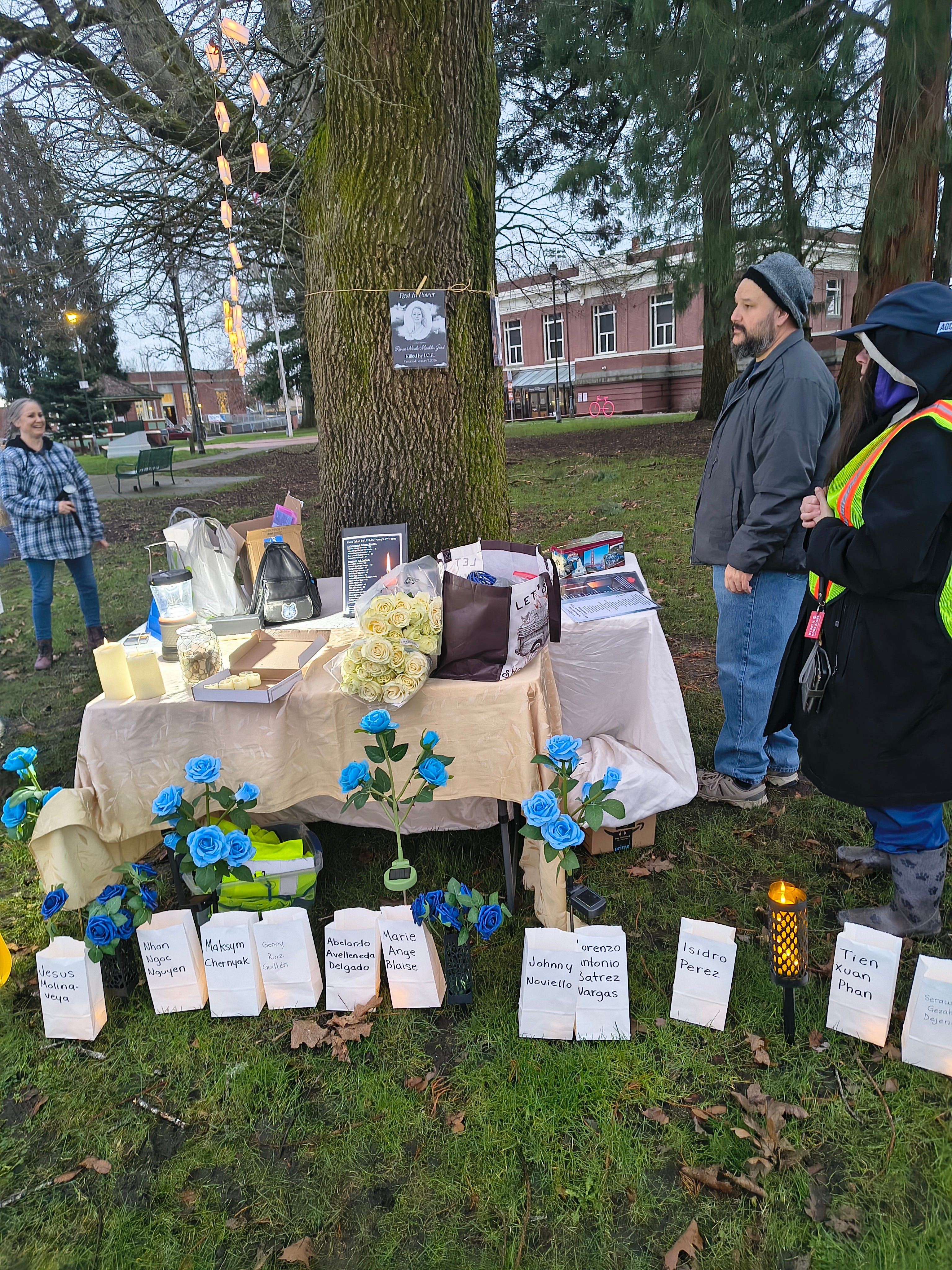
Impromptu vigil in Centralia, Washington, for Renee Good and all those killed by ICE to date, January 11, 2026
But then there are historical moments—like now—when it seems clearly wrong to claim the privilege to stand above the fray, apart from the bonds of family and community, aside from the felt obligation to defend the country in which you happen to live. No one walks alone down these streets that have been turned mean—in Minneapolis, or in Portland, Chicago, L.A. The two people we are all mourning right now—the ones who died publicly, on camera, gunned down by federal thugs—died enmeshed in bonds, physically close to those whom they were trying to protect.
I also feel that they died trying to shine a light on all the previous, less visible deaths caused by our monstrous government and its rogue militia. Deaths that were in fact lonely in the least “privileged” way—deaths far from family; deaths in custody, custody of the supposed “law” that had been turned against them because they were the wrong color or had the wrong pedigree or the wrong papers or who didn’t have papers or who did but it didn’t even matter because they’d already been deemed expellable anyway.
“So Bad Even the Introverts Are Here” says a popular protest sign. It acknowledges the truth that sometimes you’re never lonelier than when you’re in a crowd. I’ve been anonymous in several loud crowds recently. So I can attest, it’s lonely.
It feels hopeless. They are trying to kill us. And they want us to feel hopeless. They want us to feel lonely. And we can feel our feelings. We can feel as lonely as we want to, individually. But the flip side of our American myth of rugged individualism is the American reality of individual stubbornness. Cussedness. All our heroes, white and male or not, have this quality. America is the story of loners who gathered in groups and fought back when some powerful evil entity tried to erase their communities.
Whose streets? Our streets, only as mean as we let them be.